 Chinese
In this class, we’ll explore a delightful and essential topic for any language learner: Chinese food. Chinese cuisine is famous worldwide for being tasty, healthy and incredibly varied.
Chinese food vocabulary (中国菜)
Pastries and buns (面食)
These are some of the staple dishes you’ll find at breakfast and dinner:
Shuǐ jiǎo (水餃): Boiled dumplings.
Mán tou (饅頭): Steamed buns (usually unfilled).
Bāo zi (包子): Steamed filled buns.

水餃很好吃,尤其是在冬天。


Boiled dumplings are delicious, especially in winter.
Rice and noodles (米饭与面条)
The heart of the Chinese diet. Note how the name changes depending on the preparation:
Bái fàn (白飯): Steamed white rice.
Chǎo miàn (炒麵): Fried noodles.
Chǎo mǐ fěn (炒米粉): Fried rice noodles.
Xiā rén chǎo fàn (蝦仁炒飯): Fried rice with prawns.
我喜欢吃蝦仁炒飯。
I like eating fried rice with prawns
Popular main courses
If you visit a restaurant, here are some of the most iconic dishes you should try:
Běi jing kǎoyā (北京烤鴨): Peking duck.
Má pó dòufu (麻婆豆腐): Spicy tofu (a classic dish of Sichuan cuisine).
Hóng shāo yú (紅燒魚): Fish cooked in soy sauce.
Dàn bǐng (蛋餅): Egg pancake.
我想吃北京烤鴨,因为它很有名。
I want to eat Peking duck because it’s very famous.
Soups (汤)
Perfect as an accompaniment to any meal:
Dànhuātāng (蛋花湯): Egg and vegetable soup.
Suān là tāng (酸辣湯): Spicy and sour soup.
Zǐ cài tāng (紫菜湯): Seaweed soup.
酸辣湯很适合搭配任何一顿饭。
This spicy soup is perfect with any meal.
Meat and protein:
Ròu (肉): Meat in general, although unless otherwise specified, this usually refers to pork (zhūròu).
Jīròu (鸡肉): Chicken.
Niúròu (牛肉): Beef.
Xiā (虾): Prawns or shrimp
💡 Important Cultural Note
The names of dishes you are familiar with in your own country may differ from those you will find in China or Taiwan. Many dishes change their name or preparation when exported, so learning these terms will help you identify authentic food when travelling.
The art of tea: The 6 varieties
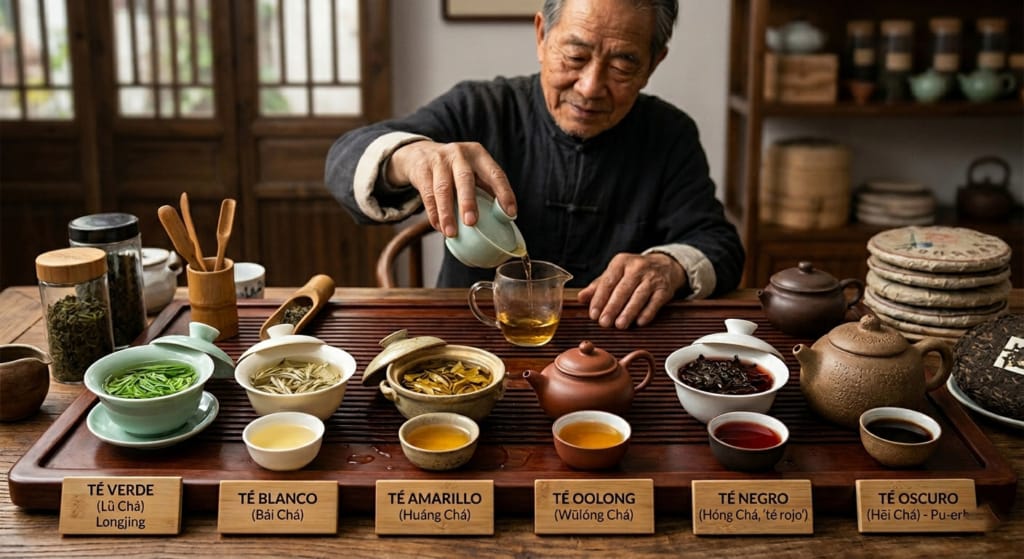
Tea is central to Chinese culture and is primarily classified by its level of oxidation. The six main types are:
Green Tea (Lǜ Chá): Unoxidised, fresh and grassy. Famous examples include Longjing (Dragon Well).
White Tea (Bái Chá): Minimally processed, delicate and naturally sweet.
Yellow Tea (Huáng Chá): Rare and mild, with a special ‘sealed yellowing’ process.
Oolong Tea (Wūlóng Chá): Semi-oxidised, with a spectrum ranging from floral to toasty notes.
Black Tea (Hóng Chá): In China it is called ‘red tea’ due to the colour of its infusion; it is fully oxidised and malty.
Dark Tea (Hēi Chá): Post-fermented and earthy, such as the famous Pu-erh, which improves with age
Interesting facts and etiquette (Table manners)
Mastering etiquette shows respect for the culture and helps you win over your hosts:
Chopsticks (Kuàizi): Never leave chopsticks standing upright in a bowl of rice, as this is reminiscent of incense burned for the deceased and is associated with death. Nor should you point at people with them.
The ‘Finger Bow’: When someone serves you tea, show your thanks by gently tapping the table twice with your index and middle fingers. This tradition mimics a bow and originates from a legend about an emperor travelling incognito.
Seats of Honour: The guest of honour usually sits facing the door (shàngzuò), whilst the host sits opposite them to facilitate service.
Sharing is key: Dim Sum (which means ‘touch the heart’) and other dishes are usually ordered as family-style dishes to share, often using a rotating platter called a Lazy Susan in the centre of the table.
Paying the bill: In China, splitting the bill is uncommon. Normally, the host pays, and it is a common ritual for guests to ‘compete’ amicably to try and pay.
Regional diversity: The 8 culinary traditions (Bā dà càixì)
Chinese cuisine is not uniform; it is divided into eight major regional styles that reflect the country’s geography:
Sichuan (Chuān Cài): Famous for its spicy seasoning and the use of Sichuan pepper, which numbs the mouth.
Guǎngdōng (Yuè Cài): Known as Cantonese cuisine; it is mild, notable for its stews, and is the birthplace of dim sum.
Húnán (Xiāng Cài): Even spicier than Sichuan cuisine, with intense, smoky flavours.
Shāndōng (Lù Cài): One of the oldest, with savoury flavours and frequent use of seafood and vinegar.
Other branches include Jiangsu, Anhui, Zhejiang and Fujian, each with specialities ranging from sweet to wild