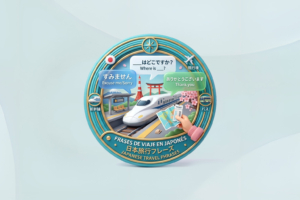
Japanese words that express politeness
In Japan, good manners can open every door. If you could only learn three words, they should be these:
Sumimasen (すみません): This is the Swiss Army knife of Japanese. It means “excuse me,” “sorry,” and can even be used to say thanks in a “sorry for the trouble” kind of way. Use it to call a waiter or if you bump into someone on the subway.
Arigatou gozaimasu (ありがとうございます): The formal way to say “thank you.” If you only say Arigatou, it sounds more casual, like talking to a friend. When traveling, it’s better to use the longer version to sound extra polite.
Onegaishimasu (お願いします): It means “please.” It’s used when asking for something specific (a coffee, a ticket, or help).
Asking for directions
Imagine yourself in the middle of Shinjuku, Google Maps goes crazy, and you have no idea where the station is. Here’s how to ask for help like a pro:
Key phrase: [Place] + wa doko desu ka? (Where is [Place]?)
は (wa): This is a particle used to mark the topic of the sentence (in this case, the place).
どこ (doko): It means “where?”.
ですか (desu ka): This is the verb “to be” turned into a question thanks to the final か (ka), which works like a question mark in English.
| English | Kanji / Kana | Romaji (Pronunciation) |
| Station | 駅 (えき) | Eki |
| Bathroom / Restroom | お手洗い (おてあらい) | Otearai |
| Hotel | ホテル | Hoteru |
| Convenience store (like 7-Eleven) | コンビニ | Konbini |
| Hospital | 病院 (びょういん) | Byōin |
| Restaurant | レストラン | Resutoran |
Real example

すみません、駅はどこですか?(Sumimasen, eki wa doko desu ka?)


Excuse me, where is the station?

Japanese vocabulary – Buildings in the City
Reference sheet with basic vocabulary for familiarizing yourself with common places in a city
11Kb
An even more natural way: “I want to go to…”
Sometimes, instead of asking where something is, you want to say: “Excuse me, I want to go to this place, how do I get there?”. For that, we use the structure 〜に行きたいです (~ ni ikitai desu).
If you add Sumimasen at the beginning and a ga… at the end (which softens the sentence like saying “but…”), you’ll sound incredibly natural.
Model phrase: すみません、東京駅に行きたいんですが…
Real example
すみません、東京駅に行きたいんですが…(Sumimasen, Tōkyō-eki ni ikitai n desu ga…)

Excuse me, I want to go to Tokyo Station, but… (could you help me?)
By leaving the sentence “hanging” with that ga…, Japanese people will immediately understand that you need directions and will start helping you.
What might they answer? (A quick listening guide)
There’s no point asking for directions if you can’t understand the answer, right? Most likely, people will point with their finger or even walk you there (yes, Japanese people really are that helpful!), but keep an ear out for these key direction words:
あっち (Atchi) / あそこ (Asoko): Over there / That thing over there (while pointing).
まっすぐ (Massugu): Straight ahead.
右です (Migi desu): It’s on the right.
左です (Hidari desu): It’s on the left.
Did you know that in Japan streets usually don’t have names? With a few exceptions like some major avenues in Kyoto or Tokyo, the Japanese address system is based on blocks, districts, and numbers rather than street names like in Western countries.
When it’s time to eat (The most important part!)
Walking into a restaurant in Japan feels like a mystical experience. As soon as you enter, the first thing you’ll hear is a loud “Irasshaimase!” (Welcome!). Don’t panic — you don’t need to answer anything, just smile.
To ask for the bill:
お会計、お願いします。Okaikei, onegaishimasu.
To say something tastes good:
美味しいです!Oishii desu! (It’s delicious!).
For people who don’t know what to order:
おすすめは?Osusume wa? (What do you recommend?).
The final touch: How much does it cost?
Shopping in Akihabara or Ginza is basically unavoidable. Learn these phrases and you’re already halfway there:
これはいくらですか。Kore wa ikura desu ka? (How much does this cost?).
これをください Kore o kudasai. (I’ll take this, please).
A little trick: If they tell you the price and you don’t understand a single number, don’t worry. They’ll usually show it to you on a calculator or the cash register screen. Just nod your head and say “Hai” (Yes).
Traveler fun facts
Silence is golden: On trains and subways, you’ll notice that nobody talks on the phone and people speak very quietly. It’s an unwritten rule: don’t bother the person next to you.
Cash is king: Although many places now accept cards, you’ll still need Japanese Yen in cash for temples, street stalls, and older vending machines.
Tipping? Absolutely not!: Don’t even think about leaving a tip at a restaurant. In fact, if you leave coins behind, there’s a good chance the waiter will run after you to return them because they’ll think you forgot your money.
If you want to keep learning Japanese, check out our Japanese classes. Improve your vocabulary, learn how to write and pronounce words, or practice your Japanese listening skills.