
Igbo language
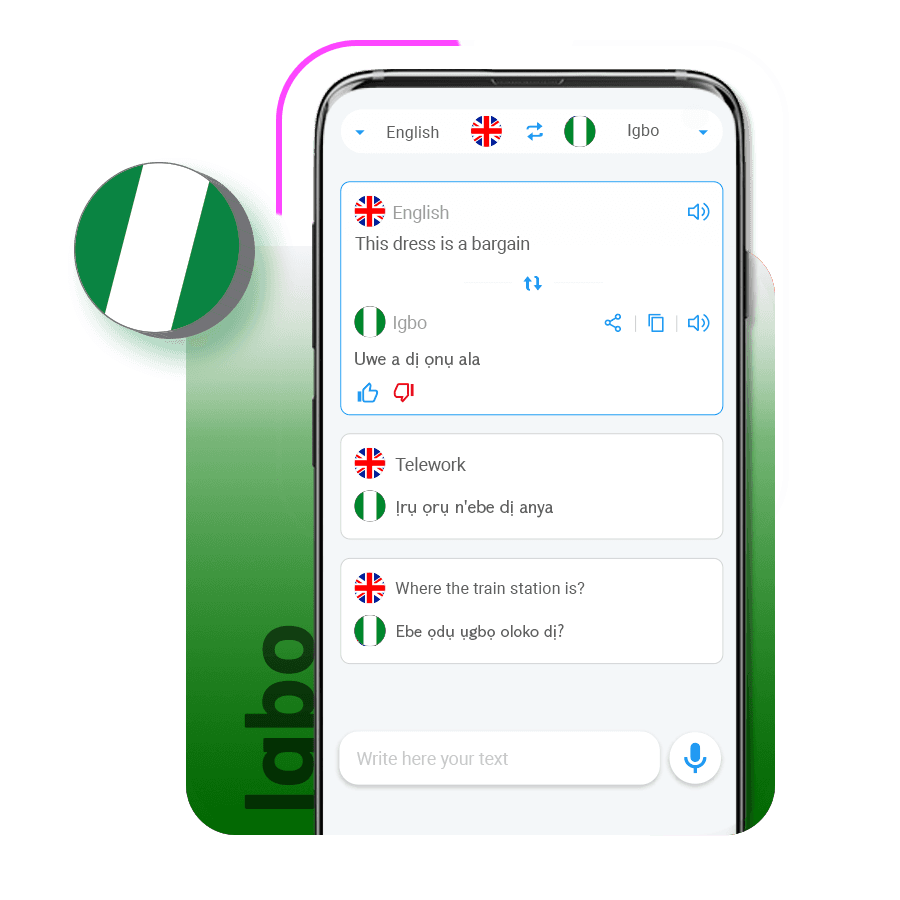
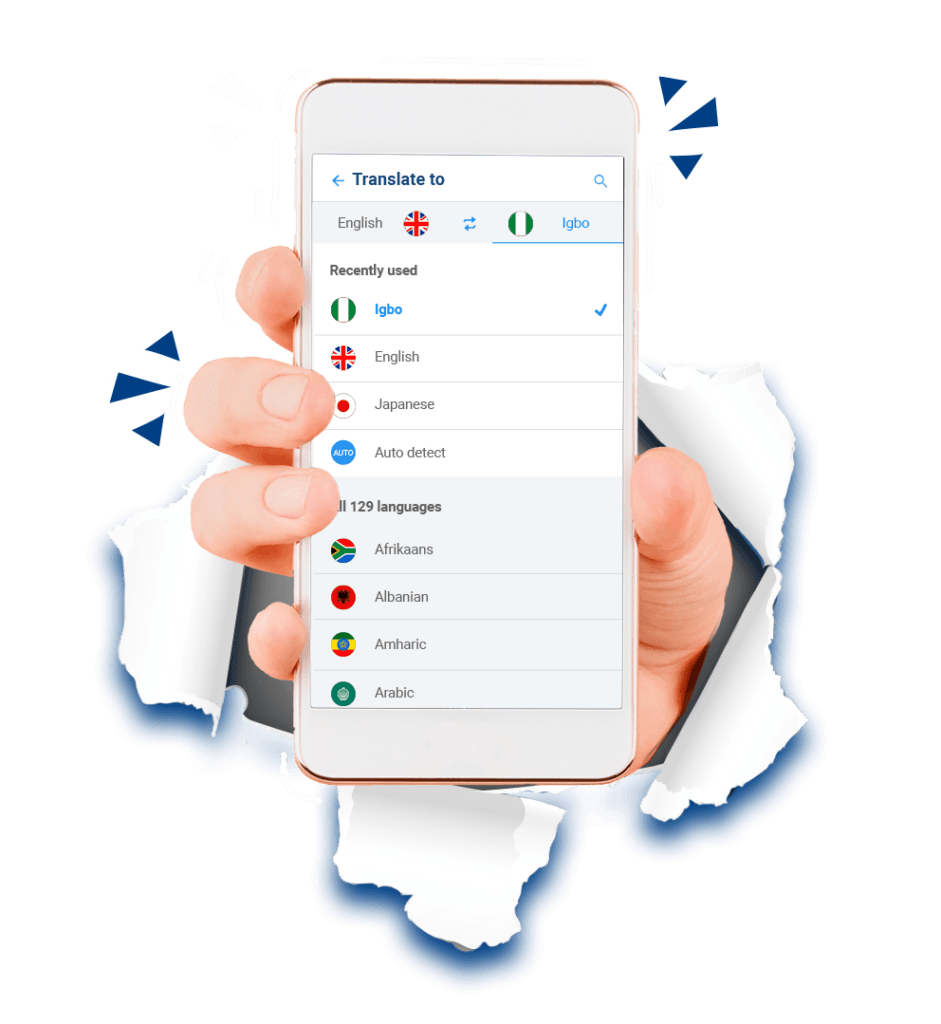
We can help you translate your voice and any text into Igbo and more than 125 other languages.




Why is it important to be able to translate into Igbo?

Where is it spoken?
Nigeria (mainly in the southeastern states) – Cameroon (some communities)
There are also significant speaker communities in: United Kingdom – United States – Canada

Number of speakers
More than 30 million native speakers.
Around 32 million speakers worldwide.

Language family
Niger–Congo – Volta–Niger – Igboid
Translation into Igbo is becoming increasingly important due to the economic and demographic growth of Nigeria, the most populous country in Africa. Igbo is one of the country’s main languages and is an essential part of the cultural identity of millions of people in southeastern Nigeria and in diaspora communities.
With more than 30 million native speakers, Igbo plays a key role in education, the media, local commerce, and cultural production. Translating into Igbo facilitates communication with an active and entrepreneurial population while improving access to services, products, and digital content.
The language is also highly relevant for businesses, educational institutions, international organizations, and development projects operating in Nigeria. As the country’s digitalization continues to expand, the demand for Igbo translations for mobile apps, websites, educational materials, and customer support is steadily increasing.
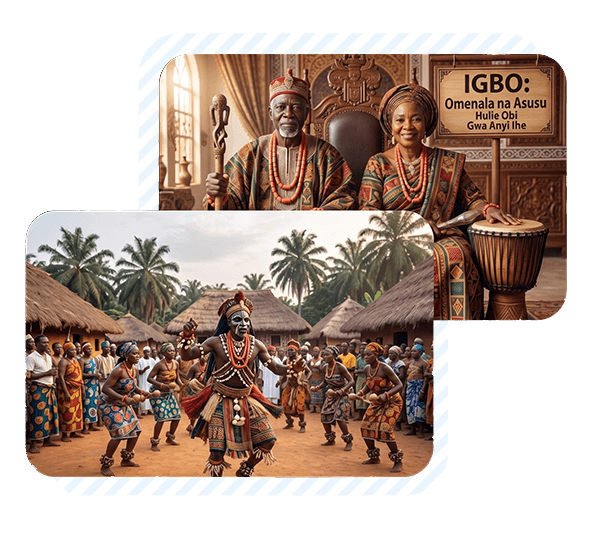
From a cultural perspective, Igbo has a rich oral tradition based on proverbs, folktales, and music, as well as a remarkable body of contemporary literature that has contributed to the international recognition of Igbo culture.
For this reason, translating into Igbo not only enables communication with millions of people but also creates business, educational, and cultural opportunities in one of the most dynamic regions of West Africa.
The most translated languages into Igbo


Learn to speak Igbo like a native
Advanced vocabulary
| Igbo | English |
|---|---|
| Mmepe | Development |
| Aku na ụba | Economy |
| Agụmakwụkwọ | Education |
| Omenala | Culture |
| Nkà na ụzụ | Technology |
| Mmepe na-adịgide adịgide | Sustainable development |
More interesting facts about the Igbo language
- Igbo is one of the three major national languages of Nigeria, alongside Hausa and Yoruba.
- It is spoken mainly in southeastern Nigeria, where it is the native language of millions of people.
- Igbo uses the Latin alphabet, adapted with several diacritical marks to accurately represent its sounds and tones.
- It is a tonal language, meaning that pronunciation and tone can completely change the meaning of a word.
- Igbo culture has an extraordinary oral tradition based on proverbs, folktales, songs, and ceremonies passed down from generation to generation.
- Writer Chinua Achebe, author of the novel Things Fall Apart, played a decisive role in introducing Igbo culture to the world.
- Igbo has many dialects, although there is a standardized variety used in education, the media, and official publications.
- In recent years, the production of digital content, educational apps, and learning resources in Igbo has grown significantly to preserve and promote the language.
- The Igbo diaspora keeps the language and cultural traditions alive in countries such as the United Kingdom, the United States, and Canada.
- An increasing number of technology initiatives are incorporating Igbo into virtual assistants, mobile applications, and learning platforms to promote digital inclusion.


Enhance global communication with your voice. Our AI translator convert speech into any language.
We offer Igbo language support across multiple services

Audio and Text Translation
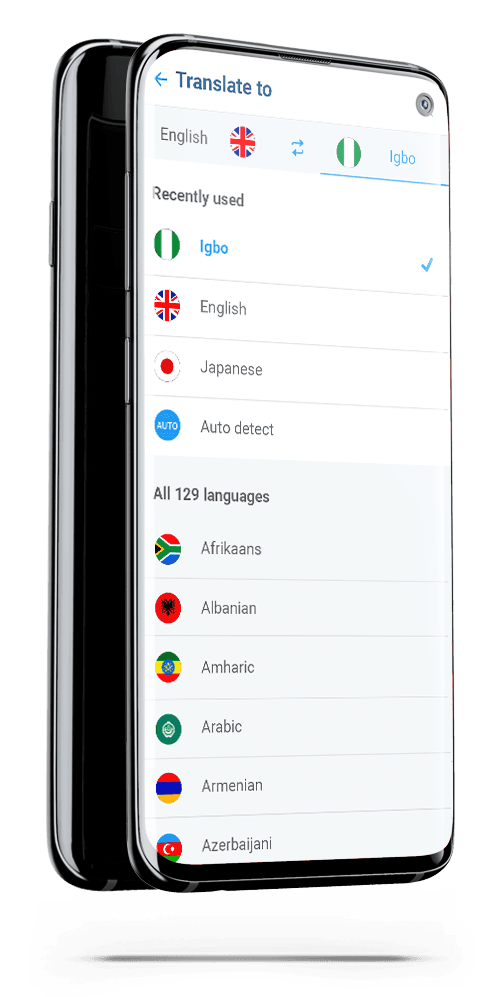
Translate Igbo to and from more than 125 available languages.

Remote Conversation Translation
Speak and translate in Igbo with people anywhere in the world remotely.

Real-Time Translation
Speak freely. Translate Igbo instantly in real time.

Learning with Smart Books
Essential expressions, culture, verbs, travel, and technical language all in one place.

Translation Audio Playback (TTS)
Listen to the translated Igbo audio to improve your pronunciation.

Speech Recognition (STT)
Speak naturally and let the app translate for you.


Enjoy the best advancements in artificial intelligence applied to translation
Translate into Igbo with maximum