Language translator to Dutch
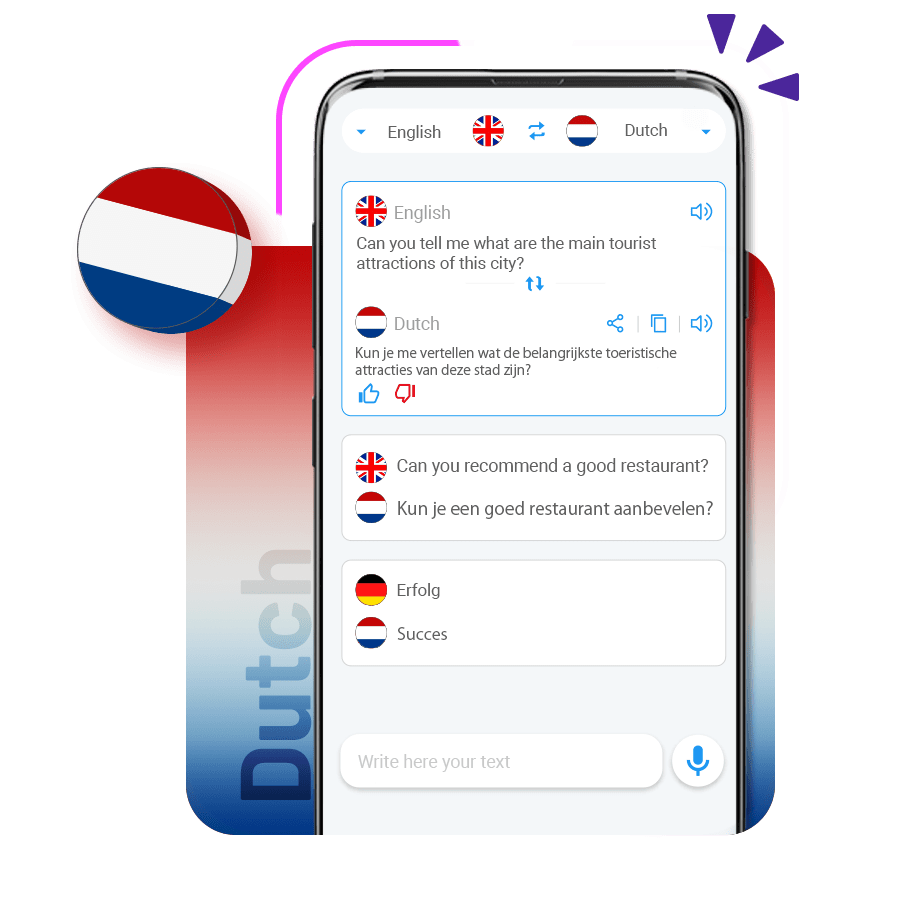
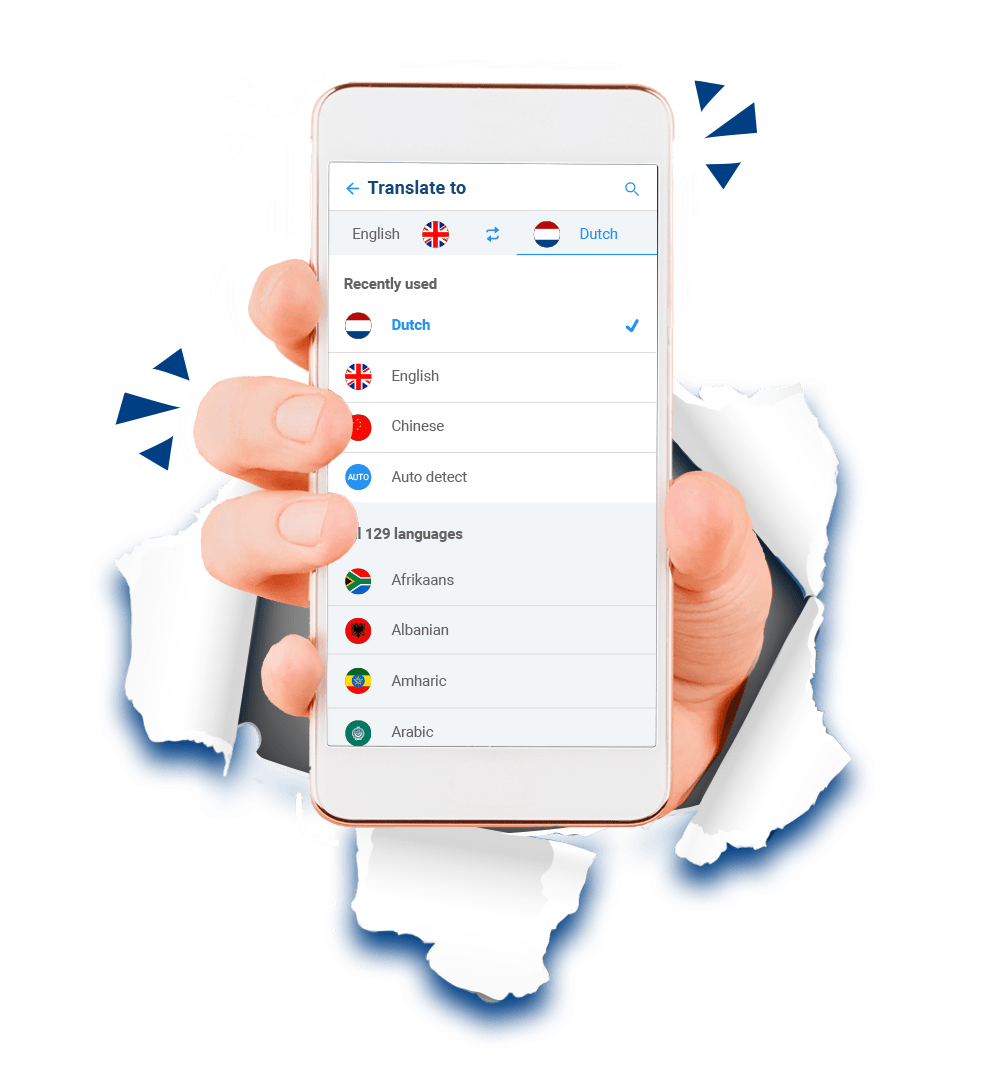
We help you translate your voice and any text into Dutch and more than 125 languages.




Why is it important to be able to translate into Dutch?

Where is it spoken?
Netherlands – Belgium (Flanders) – Suriname – Aruba – Curaçao – Sint Maarten

Number of speakers
25 million (native speakers)
30 million worldwide.

Language family
Indo-European – Germanic – West Germanic
Translation into Dutch is essential for communicating with millions of people in Europe and accessing some of the most developed and innovative markets in the world. Dutch is the official language of the Netherlands, Belgium (in the Flanders region), Suriname, and several Caribbean territories of the Kingdom of the Netherlands.
With more than 25 million native speakers and nearly 30 million speakers in total, Dutch plays a key role in international trade, logistics, technology, agriculture, and financial services. The Netherlands stands out as one of Europe’s leading hubs for innovation, e-commerce, and maritime transport.
Translating into Dutch allows companies and professionals to reach consumers with high purchasing power and facilitates expansion into markets such as the Netherlands and Flanders, two of Europe’s most economically active regions.
In addition, Dutch opens the door to a rich cultural and literary tradition, as well as to internationally prestigious universities that offer numerous programs for foreign students.
For these reasons, being able to translate into Dutch not only improves communication with millions of people but also opens up business, academic, and professional opportunities in one of Europe’s most competitive economies.
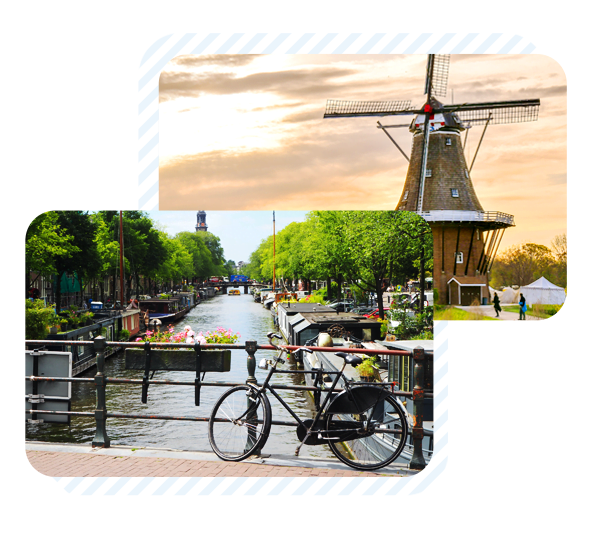
The most commonly translated languages into Dutch


Learn to speak Dutch like a native
Advanced vocabulary
| Dutch | English |
|---|---|
| Duurzaamheid | Sustainability |
| Innovatie | Innovation |
| Economie | Economy |
| Cultuur | Culture |
| Technologie | Technology |
| Wereldhandel | International trade |
Other interesting facts about the Dutch language
- Dutch is the official language of the Netherlands, as well as one of the official languages of Belgium, Suriname, and several Caribbean territories of the Kingdom of the Netherlands.
- It is the native language of more than 25 million people and one of the Germanic languages most closely related to English and German.
- The Dutch alphabet uses the 26 letters of the Latin alphabet. One of its best-known features is the digraph “ij”, which in many contexts is considered a special writing unit.
- Afrikaans, an official language of South Africa and Namibia, derives directly from 17th-century Dutch and retains much of its vocabulary and grammar.
- The Netherlands ranks among the countries with the highest levels of English proficiency in the world, so many speakers are bilingual or multilingual.
- Dutch is a very important language in sectors such as logistics, maritime trade, engineering, agriculture, renewable energy, and technology.
- In Belgium, Dutch is officially called Nederlands and is the predominant language in the Flanders region.
- The Port of Rotterdam, one of the largest ports in Europe, has historically contributed to the international expansion of the language in commercial and maritime fields.
- Every year, thousands of international students choose Dutch universities thanks to the quality of their education system and their international outlook.
Enhance global communication with your voice. Our AI translator convert speech into any language.
We support the Dutch language across multiple services
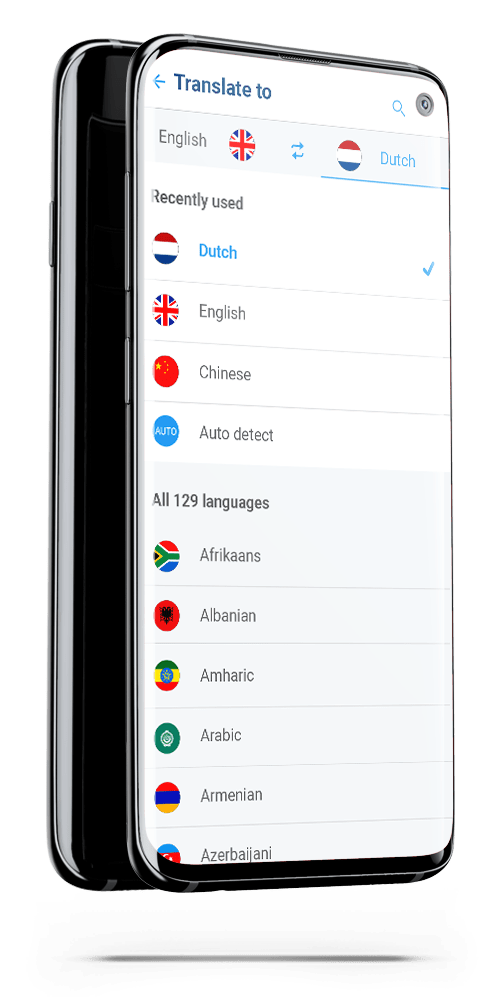

Audio and Text Translation
Translate Dutch to and from more than 125 available languages.

Remote Conversation Translation
Speak and translate into Dutch with people anywhere in the world remotely.

Real-Time Translation
Speak freely. Translate Dutch instantly in real time.

Learning with Smart Books
Expressions, essentials, culture, verbs, travel, and technical language—all in one place.

Translation Audio Playback (TTS)
Listen to the Dutch translation audio to improve your pronunciation.

Speech Recognition (STT)
Speak freely, and your app will translate for you.

Enjoy the best advancements in artificial intelligence applied to translation
Translate to Dutch with the utmost