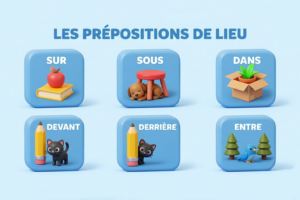
Imagine you are walking through the beautiful streets of Paris and you need to ask where the metro station is, or that you are in a hotel and want to know where they left your luggage. To answer or understand these directions, you need to know whether things are inside, outside, on top of, underneath, or next to.
Many students make the mistake of wanting to translate everything literally from Spanish. Although French and Spanish are close cousins (both come from Latin), French has its own tricks and magical combinations that, if you learn them well from the beginning, will make you sound natural and fluent. Let’s break it down step by step in a very simple way!
Simple prepositions (The ones that get straight to the point)
We call “simple” prepositions those that are just one word and do not need any extra combination to work. They are placed right before the article and the object.
Let’s look at the most important ones with real-life examples:
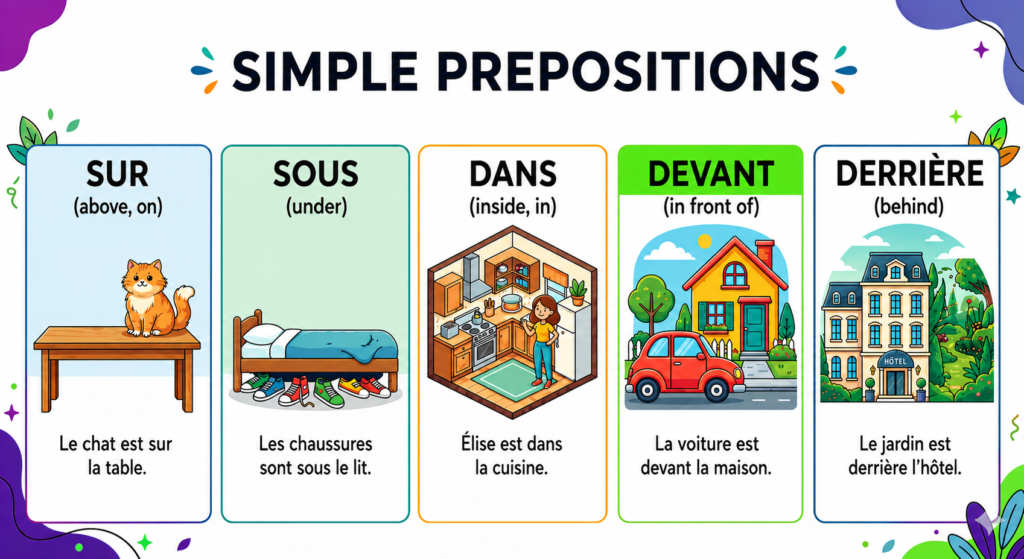
Sur (On top of / On)
Watch the pronunciation: Shape your mouth like you are saying “oo” but say “ee.” It’s a clean sound.

Le chat est sur la table.


The cat is on the table
Sous (Underneath / Below)
Pronunciation tip: Here, “ou” is pronounced like the “oo” in “food.” The final “s” is silent.
Les chaussures sont sous le lit.
The shoes are under the bed
Dans (Inside / In)
Elise est dans la cuisine.
Élise is in/inside the kitchen
Devant (In front of)
La voiture est devant la maison.
The car is in front of the house
Derrière (Behind)
Le jardín est derrière l’hôtel.
The garden is behind the hotel
Compound prepositions and “The Secret of De”
This is where French gets interesting and where Spanish speakers often stumble if we rush. There are prepositions in French that must always be followed by the word de.
For example, “next to” is à côté de, and “far from” is loin de.
What is the secret? In French, when the word de joins with the article le (masculine) or les (plural), they merge together as if they were modeling clay. Study this table carefully, because it is the golden rule to avoid mistakes:
| Combination in French | What it becomes | Example in Action | Translation |
| de + le (masculine) | du | À côté du cinéma | Next to the movie theater |
| de + la (feminine) | de la (does not change) | À côté de la banque | Next to the bank |
| de + l’ (vowel/H) | de l’ (does not change) | À côté de l’ hôtel | Next to the hotel |
| de + les (plural) | des | À côté des magasins | Next to the stores |
Once you know this fusion rule, you can confidently use the most common compound prepositions:
À côté de (Next to)
Le restaurante est à côté du musée.
The restaurant is next to the museum
Loin de (Far from)
La gare est loin de la tour Eiffel.
The station is far from the Eiffel Tower
Près de (Near / Close to)
Habitez-vous près de l’ université?
Do you live near the university?
Cultural and Linguistic Curiosity: The Mystery of the Word “Chez”
If there is one word that French students fall in love with because of its usefulness, but that initially blows their minds, it is the preposition Chez (pronounced something like “shay”). There is no direct one-word translation for it in English.
Chez literally means “at the home of” or “at the shop/office of”.
Instead of saying a very long sentence like “I’m going to my parents’ house”, French people simply say: “Je vais chez mes parents”. It is such a powerful word that it is also used when going to the doctor, the baker, or the hairdresser:
- Je vais chez le médecin. (I’m going to the doctor / to the doctor’s office).
- Je suis chez moi. (I am at home).
French people have a deeply rooted sense of hospitality and personal space; that is why using chez not only indicates a physical place, but also conveys a feeling of belonging, warmth, and respect for another person’s space.
Exercises on French prepositions of place
Quiz