

Afrikaans language
We help you translate your voice and any text into bulgarian and more than 125 languages.




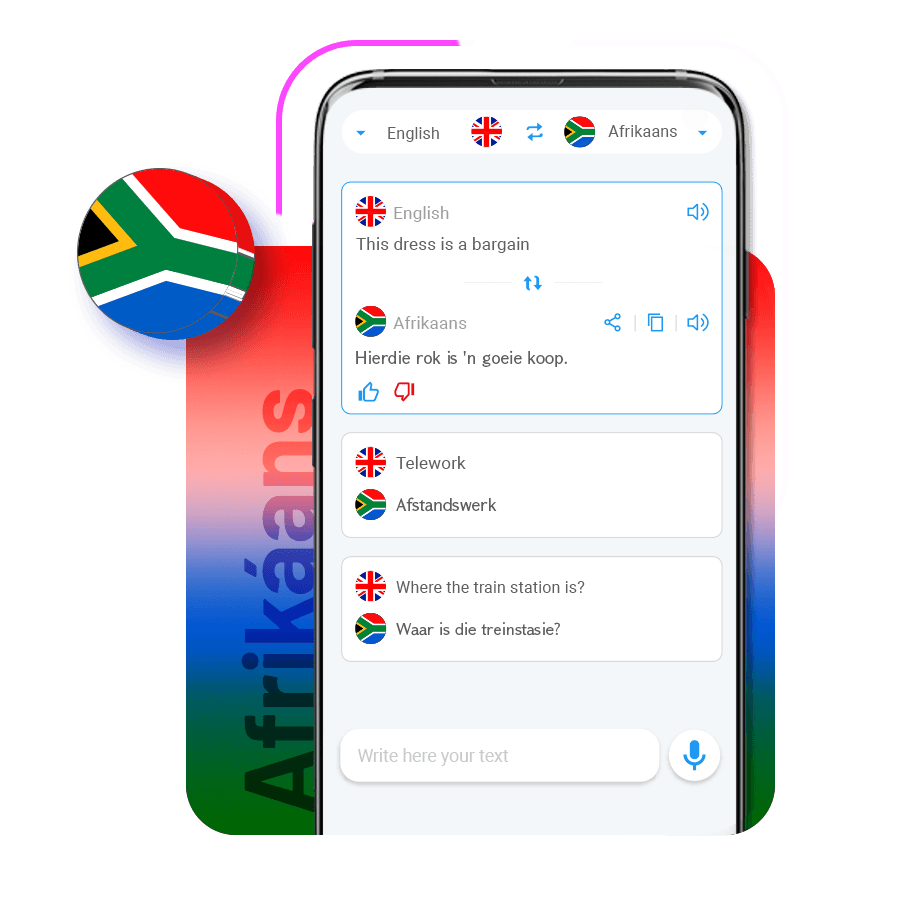
Why is it important to be able to translate into Afrikaans?

Where is it spoken?
South Africa – Namibia – Botswana – Zimbabwe – United Kingdom – Australia – New Zealand – Canada – United States

Number of speakers
More than 7 million native speakers.
Approximately 10 million speakers in total.

Language family
Indo-European family – Germanic branch – West Germanic group – Derived from Dutch
Afrikaans is one of the official languages of South Africa and also has official recognition in Namibia. It is spoken by more than 7 million people as their native language and by nearly 10 million people when those who use it as a second language are included.
Translation into Afrikaans is especially useful for business communication, tourism, education, and trade relations in Southern Africa. It is also one of the most widely used languages in South African media, literature, and public administration.
Afrikaans is primarily descended from 17th-century Dutch, although it has incorporated influences from English, German, Portuguese, Malay, and various African languages, giving rise to a language with its own distinct identity.
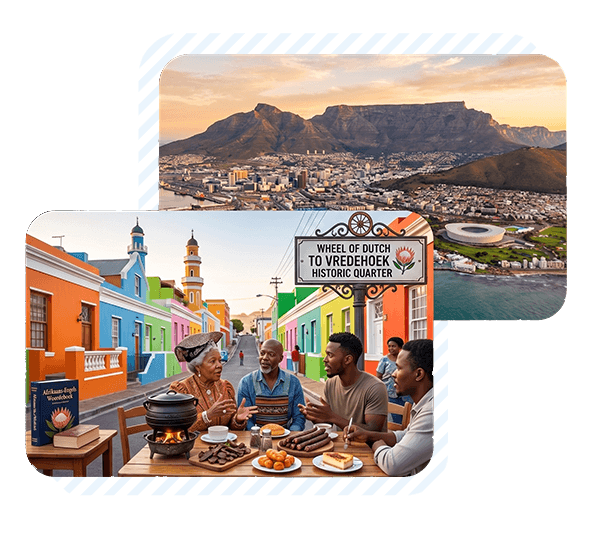
The most commonly translated languages into Afrikaans


Learn to speak Afrikaans like a native
Advanced Vocabulary
| Afrikaans | English |
|---|---|
| Verantwoordelikheid | Responsibility |
| Geleentheid | Opportunity |
| Uitdaging | Challenge |
| Samewerking | Collaboration |
| Onafhanklikheid | Independence |
| Prestasie | Achievement |
Other interesting facts about the Afrikaans language
- It is one of the youngest languages in the world. It emerged between the 17th and 18th centuries from the Dutch spoken by settlers in South Africa.
- Its grammar is very simple. Unlike Dutch or German, verbs barely change according to the subject, and there are no complex conjugations.
- It has no grammatical gender. Nouns are not classified as masculine, feminine, or neuter, which makes the language easier to learn.
- It is one of South Africa’s twelve official languages. It coexists with languages such as English, Zulu, Xhosa, Sesotho, and Tswana.
- It has been influenced by many cultures. In addition to Dutch, it includes vocabulary from English, German, Portuguese, Malay, and various African languages.
- It has an important literary tradition. Afrikaans has a rich body of novels, poetry, and drama and is one of the main publishing languages in South Africa.
- It is fairly easy for Dutch speakers to understand. Although there are differences in vocabulary and pronunciation, the two languages retain a high degree of mutual intelligibility.
- Its use continues to grow online and in digital media. An increasing number of educational resources, multimedia materials, and applications are available in Afrikaans.


Enhance global communication with your voice. Our AI translator convert speech into any language.
We support the Afrikaans language across multiple services
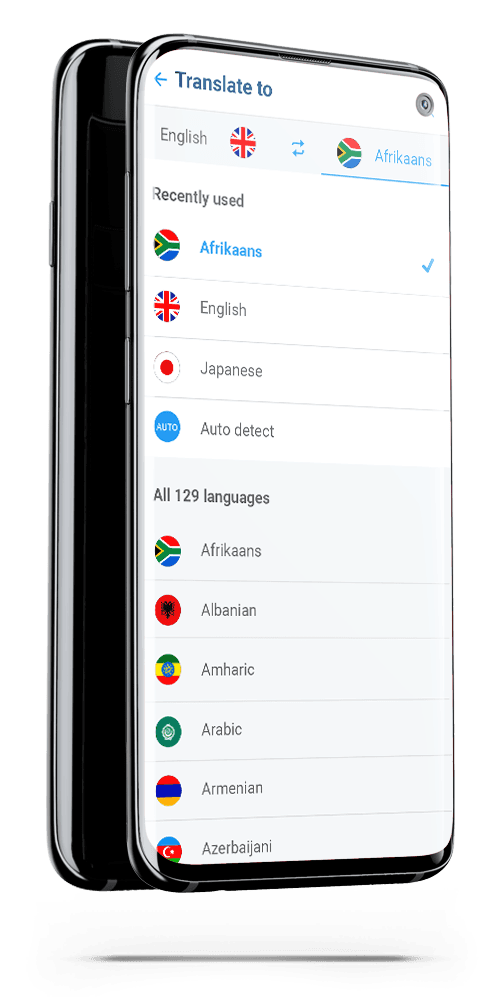

Audio and text translation
Translate Afrikaans to and from more than 125 available languages.

Remote conversation translation
Speak and translate into Afrikaans with people anywhere in the world remotely.

Real-Time translation
Speak freely. Translate Afrikaans instantly in real time.

Learning with smart books
Expressions, essentials, culture, verbs, travel, and technical language—all in one place.

Translation audio playback (TTS)
Listen to the Afrikaans translation audio to improve your pronunciation.

Speech recognition (STT)
Speak freely, and your app will translate for you.


Enjoy the best advancements in artificial intelligence applied to translation
Translate to Afrikaans with the utmost