

Language Translator to Korean
We help you translate your voice and any text into Korean and more than 125 languages.




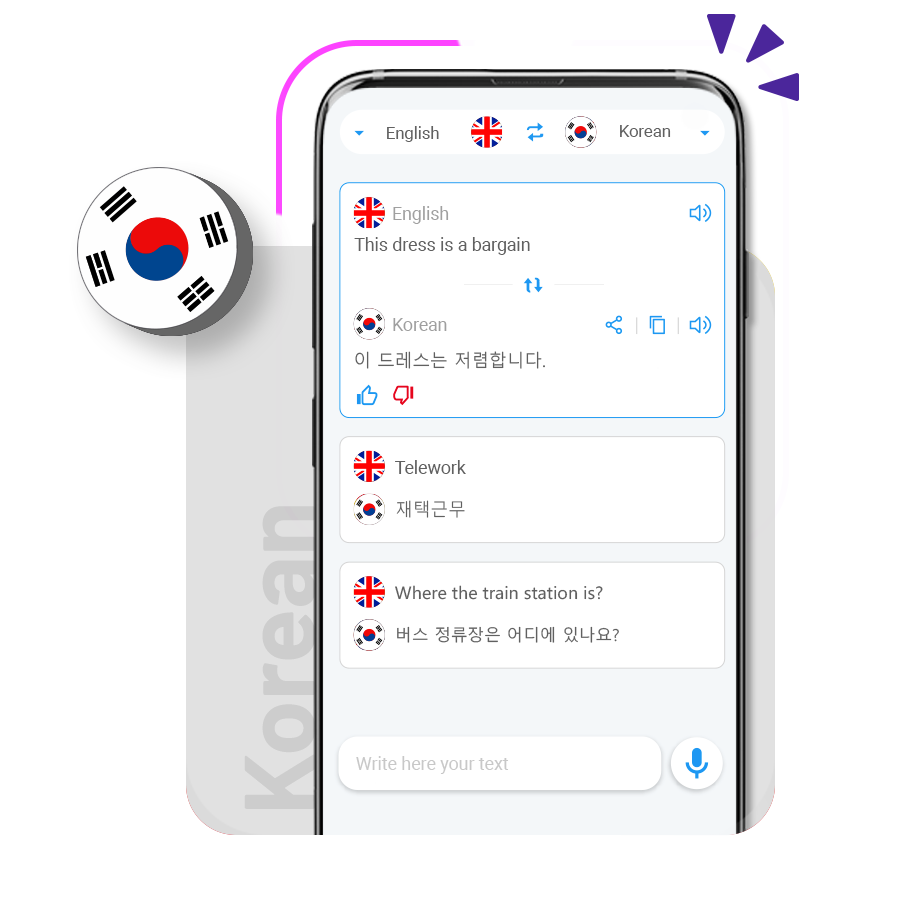
Why is it important to be able to translate into Korean?

Where is it spoken?
South Korea – North Korea – United States – Canada – Japan – China – Australia

Number of speakers
80 million (native speakers)
82 million worldwide.

Language family
Koreanic (a language isolate according to the most widely accepted classification).
Translation into Korean is becoming increasingly important due to South Korea’s growing international relevance as a technological, industrial, and cultural powerhouse. Korean is the official language of both South Korea and North Korea and is spoken by millions of people in communities around the world.
With more than 80 million native speakers, Korean is essential for establishing business relationships with leading companies in industries such as electronics, automotive manufacturing, artificial intelligence, video games, and biotechnology. Many South Korean multinational corporations operate globally, increasing the demand for professional translations and communication tools in this language.
In addition, the expansion of the Hallyu, or “Korean Wave,” has fueled interest in the language thanks to the global success of K-pop, K-dramas, films, cuisine, and cosmetics. Every year, millions of people begin learning Korean to better understand this culture or to access academic and professional opportunities.
Translating into Korean also provides access to a highly advanced digital market, where e-commerce, mobile applications, and technology services play a major role.
For these reasons, being able to translate into Korean not only improves communication with millions of people but also opens the door to new professional, business, and cultural opportunities in one of the world’s most innovative economies.

The Most Commonly Translated Languages into Korean


Learn to speak Korean like a native
Advanced vocabulary
| Korean | English |
|---|---|
| 지속 가능성 | Sustainability |
| 기술 | Technology |
| 혁신 | Innovation |
| 경제 | Economy |
| 문화 | Culture |
| 인공지능 | Artificial Intelligence |
Other interesting facts about the Korean language
- Korean uses Hangul (한글), an alphabet created in 1443 by King Sejong the Great and officially promulgated in 1446 to improve literacy among the population.
- Many linguists consider Hangul to be one of the world’s most scientific and efficient writing systems thanks to its logical and phonetic design.
- Although South Korea and North Korea share the same language, there are differences in vocabulary, pronunciation, and some spelling conventions due to decades of separate development.
- Korean uses different speech levels depending on age, social status, and the relationship between speakers, making respect a fundamental aspect of communication.
- South Korea is one of the world’s most technologically advanced and highly connected countries, driving strong demand for software, video game, app, and digital content translation into Korean.
- The global success of K-pop, K-dramas, Korean cinema, and Korean cuisine has dramatically increased the number of Korean language learners worldwide over the past two decades.
- Many Korean words are of Chinese origin (Hanja), although Hangul is now the writing system used almost exclusively in everyday life in South Korea.
- Every October 9, South Korea celebrates Hangul Day, a national holiday commemorating the creation of its alphabet.

Enhance global communication with your voice. Our AI translator convert speech into any language.
We support the Korean language across multiple services
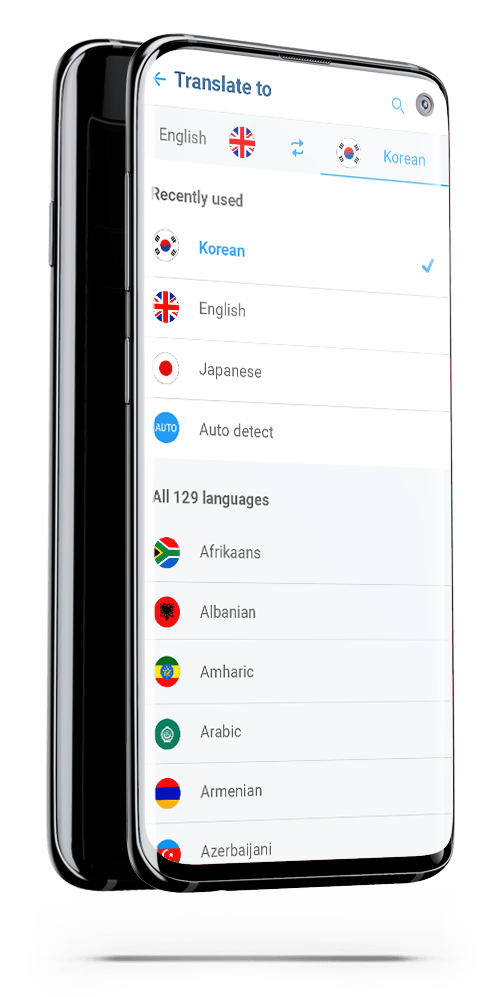

Audio and text translation
Translate Korean to and from more than 125 available languages.

Remote conversation translation
Speak and translate into Korean with people anywhere in the world remotely.

Real-Time translation
Speak freely. Translate Korean instantly in real time.

Learning with smart books
Expressions, essentials, culture, verbs, travel, and technical language—all in one place.

Translation audio playback (TTS)
Listen to the Korean translation audio to improve your pronunciation.

Speech recognition (STT)
Speak naturally, and the app will translate for you in real time.


Enjoy the best advancements in artificial intelligence applied to translation
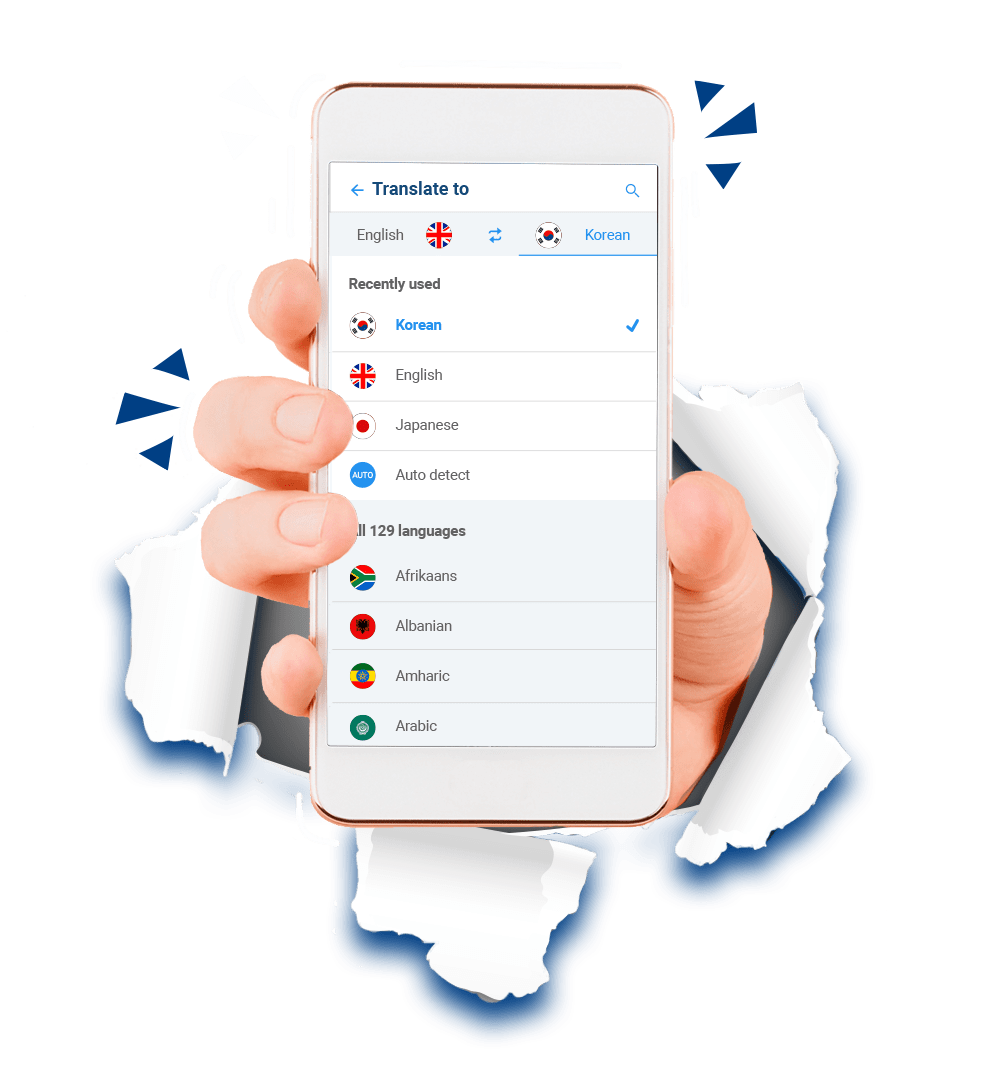
Translate into Korean as accurately as possible