

Translate into Swahili
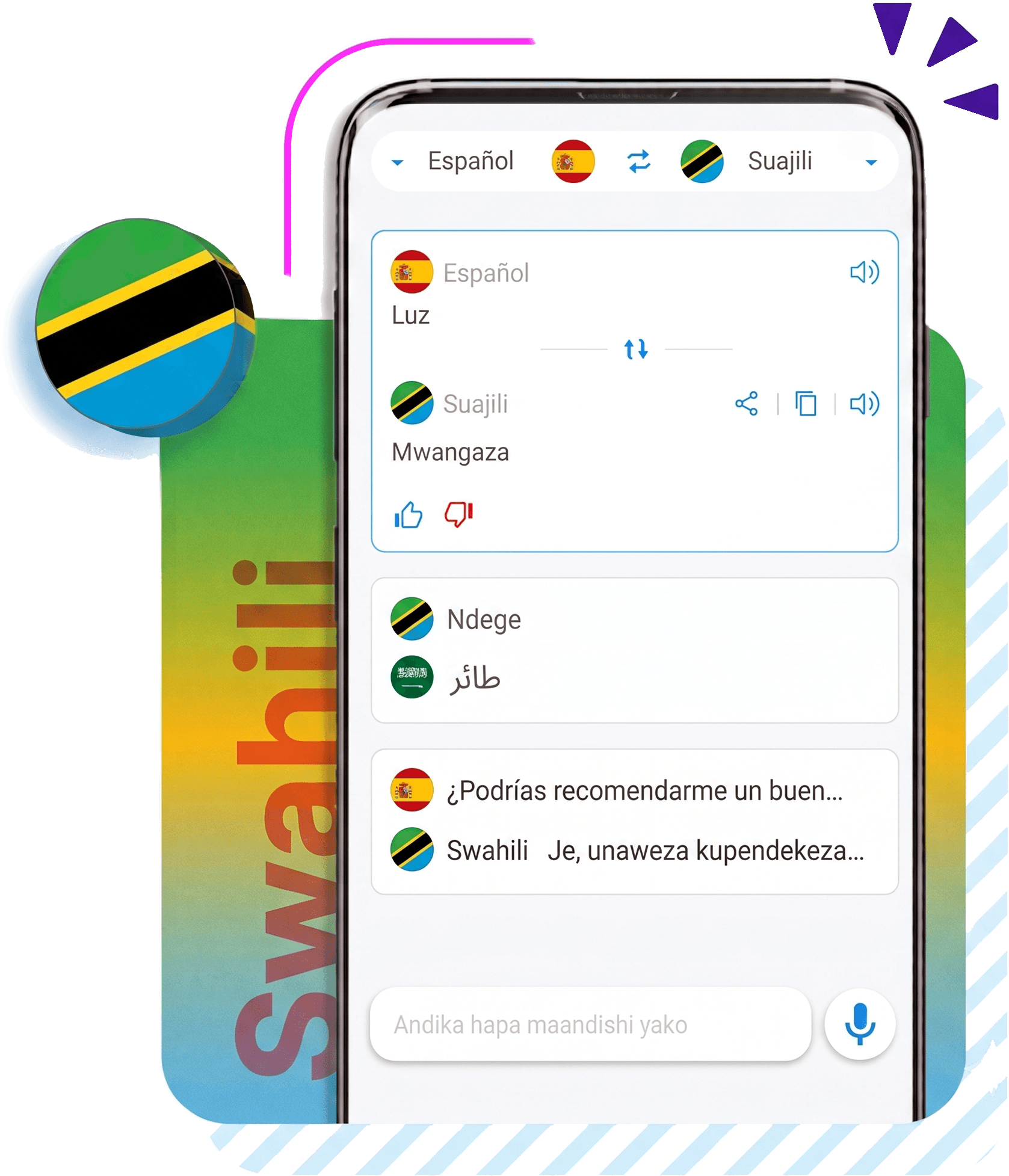
We help you translate your voice and any text into Swahili and more than 125 languages.




Why is it important to be able to translate into Swahili?

Where is it spoken?
Tanzania – Kenya – Uganda – Democratic Republic of the Congo – Rwanda – Burundi – Mozambique (some regions) – Comoros

Number of speakers
Between 15 and 20 million native speakers
80 million speakers worldwide.

Language family
Niger-Congo – Bantu
Translating into Swahili is becoming increasingly important due to the economic and demographic growth of East Africa. Swahili is one of the most widely spoken African languages and serves as a common language among people from different ethnic and linguistic backgrounds.
With more than 80 million speakers, including native speakers and those who use it as a second language, Swahili plays a key role in trade, education, tourism, and international relations across the region. In addition to being an official language in several countries, it is also one of the working languages of major African organizations.
Translating into Swahili makes it easier to communicate with emerging markets such as Kenya, Tanzania, and Uganda, where sectors including tourism, technology, agriculture, and e-commerce continue to experience steady growth. It is also essential for international organizations, NGOs, and cooperation projects operating throughout Africa.
From a cultural perspective, Swahili has a rich oral and literary tradition that blends African, Arab, and Persian influences. Its music, poetry, and history reflect centuries of cultural exchange along the Indian Ocean coast.
For these reasons, being able to translate into Swahili not only enables communication with millions of people but also opens up business, educational, and cultural opportunities in one of the fastest-growing regions of the African continent.

The most translated languages into Swahili


Learn to speak Swahili like a native
Advanced vocabulary
| Swahili | English |
|---|---|
| Maendeleo | Development |
| Uchumi | Economy |
| Elimu | Education |
| Utamaduni | Culture |
| Teknolojia | Technology |
| Uendelevu | Sustainability |
More interesting facts about the Swahili language
- Swahili, internationally known as Swahili (Kiswahili in the language itself), is one of the most widely spoken African languages and serves as a lingua franca across much of East Africa.
- Since 2022, Swahili has been one of the official languages of the African Union, reflecting its growing importance across the continent.
- Although it belongs to the Bantu language family, Swahili has incorporated many words from Arabic due to centuries of trade along the Indian Ocean coast.
- Today it is written using the Latin alphabet, although for centuries an adapted version of the Arabic script was also used for religious and literary texts.
- The prefix “Ki-“ in Kiswahili means “language,” while Waswahili refers to the Swahili people.
- Swahili plays a key role in education, media, tourism, and trade across East Africa, enabling communication between people with different native languages.
- Many Swahili words are internationally recognized through films and music, such as safari (“journey”), simba (“lion”), rafiki (“friend”), and hakuna matata (“no problem”).
- An increasing number of universities in Europe, the Americas, and Asia now offer Swahili courses because of the language’s growing economic, cultural, and academic importance.
- July 7 is celebrated as World Kiswahili Language Day, proclaimed by UNESCO to recognize the international importance of the language.


Enhance global communication with your voice. Our AI translator convert speech into any language.
We support Swahili across multiple services

Audio and text translation
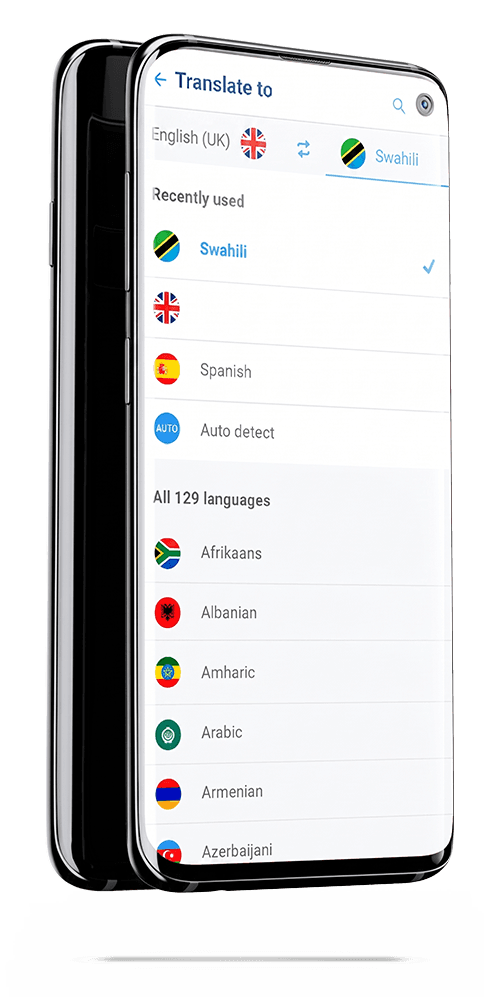
Translate Swahili into more than 125 available languages.

Remote conversation translation
Speak and translate into Swahili remotely with people anywhere in the world.

Real-time translation
Speak freely. Translate Swahili instantly in real time.

Learning with smart books
Expressions, essentials, culture, verbs, travel, and technical language all in one place.

Translation audio playback (TTS)
Listen to the Swahili translation audio to improve your pronunciation.

Speech recognition (STT)
Speak freely, and the app will translate for you.


Enjoy the best advancements in artificial intelligence applied to translation
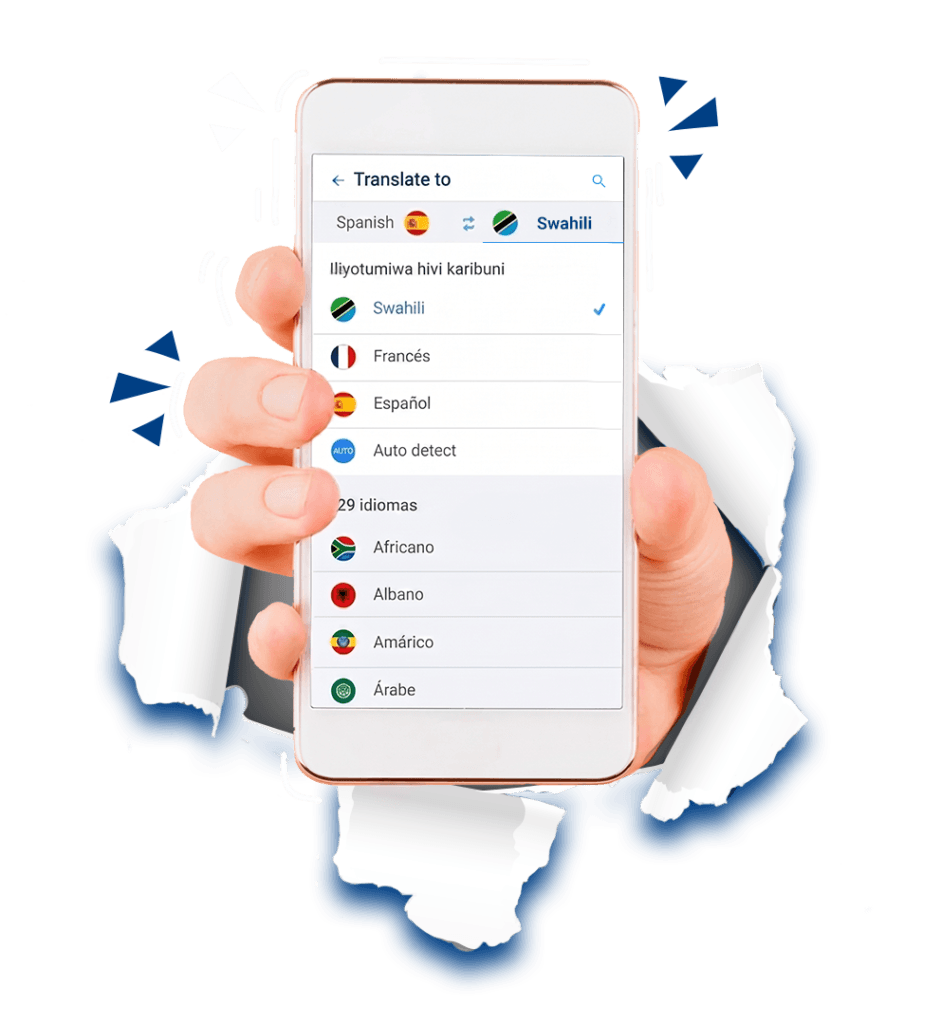
Translate into Swahili with maximum