

Scottish language
We help you translate your voice and any text into scottish and more than 125 languages.




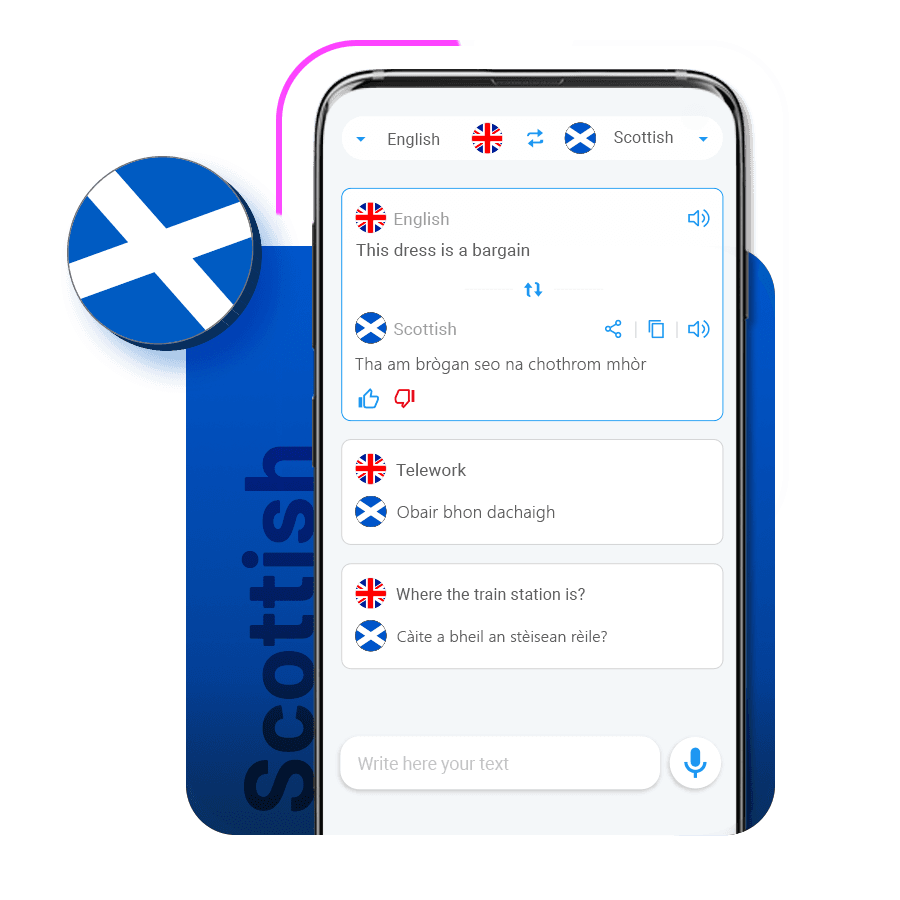
Why is it important to be able to translate into Scottish Gaelic?

Where is it spoken?
Scotland (United Kingdom) – Canada (Nova Scotia) – Australia – United States – New Zealand

Number of speakers
Approximately 60,000 native and interactive speakers.
More than 130,000 people with knowledge of the language.

Language family
Indo-European family – Celtic branch – Goidelic sub-group
Scottish Gaelic (Gàidhlig) is the historic Celtic language of the Highlands and Islands of Scotland. It has around 60,000 active speakers and more than 130,000 people who have knowledge of the language, driven by the ongoing educational and cultural revival across Scotland.
Translating into Scottish Gaelic plays an essential role in preserving an ancient cultural tradition, as well as in complying with official status regulations and institutional integration in Scotland across education, tourism, and public broadcasting.
As global interest grows in Highland heritage, Scottish folklore, folk music, and language immersion initiatives, having Gaelic translation tools becomes essential for students, travelers, historians, and cultural projects.

The most translated languages into Scottish Gaelic


Learn to speak the Scottish Gaelic language like a true native
Advanced vocabulary
| Scottish | English |
|---|---|
| Uallachas | Responsibility |
| Cothrom | Opportunity |
| Dùblan | Challenge |
| Co-obrachadh | Collaboration |
| Neo-eisimeileachd | Independence |
| Soirbheachas | Success |
Other curiosities about the Scottish Gaelic language
- It belongs to the Goidelic Celtic branch. It is closely related to Irish and Manx, sharing origins in Old Irish introduced to Scotland in the early centuries AD.
- It uses a Verb-Subject-Object (VSO) word order. Unlike Spanish or English, standard sentences begin with the verb at the start of the clause.
- It uses grave accents for long vowels. Modern orthography uses grave accents (à, è, ì, ò, ù) to indicate vowel length and alter word meanings.
- It has an active community in Canada. There is a living variant known as Canadian Gaelic, historically preserved on Cape Breton Island (Nova Scotia) by descendants of Scottish emigrants.
- It holds official protection and promotion status. Thanks to the Gaelic Language (Scotland) Act 2005, it enjoys official recognition in Scotland, featuring bilingual signage, its own TV channel (BBC Alba), and Gaelic-medium immersion schools.


Enhance global communication with your voice. Our AI translator convert speech into any language.
We support the Scottish language across multiple services
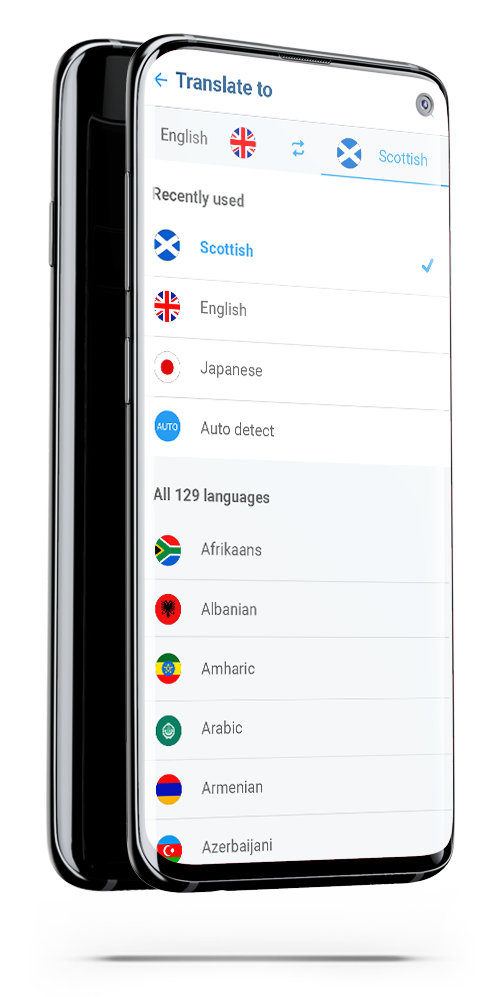

Audio and text translation
Translate Scottish between more than 125 available languages.

Remote conversation translation
Speak and translate into Scottish with people anywhere in the world remotely.

Real-time translation
Speak freely. Translate Scottish instantly in real time.

Learning with smart books
Expressions, essentials, culture, verbs, travel, and technical language all in one place.

Translation audio playback (TTS)
Listen to the Scottish translation audio to improve your pronunciation.

Speech recognition (STT)
Speak freely and let the app translate for you.


Enjoy the best advancements in artificial intelligence applied to translation
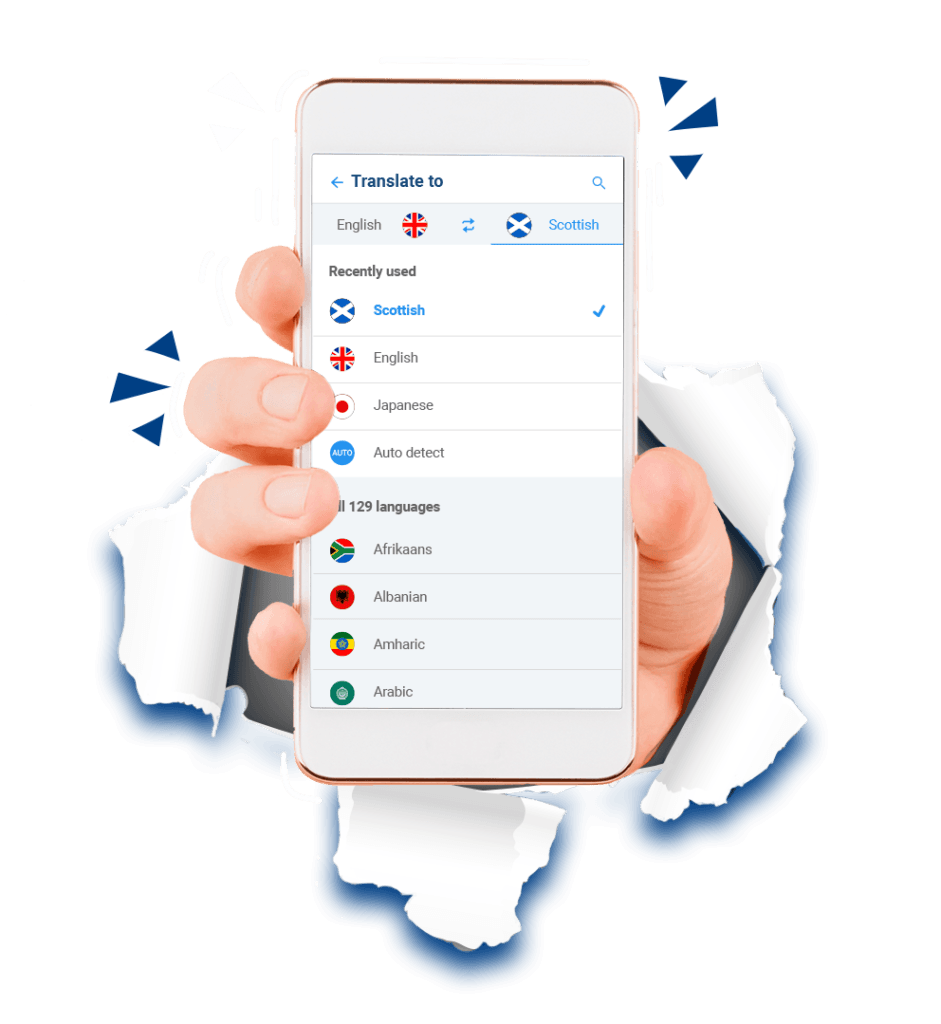
Translate to Scottish with the utmost